
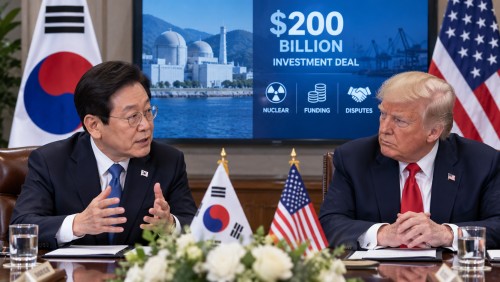
The ongoing negotiations between South Korea and the United States over a $200 billion investment commitment are fraught with challenges that could significantly impact nuclear development projects. The primary issues revolve around nuclear reactor designs, investment risks, and funding schedules, casting doubt on whether the agreement will come to fruition.
Central to the dispute is the selection of nuclear reactor technologies, with plans to construct eight reactors in the U.S. The proposed designs include six reactors based on Westinghouse’s AP1000 and two using South Korea’s APR1400 technology. However, U.S. officials and Westinghouse have expressed opposition to incorporating the Korean-designed APR1400, complicating the finalization of the nuclear package. South Korea is eyeing a substantial investment in nuclear-related projects, potentially allocating around $120 billion of its total investment.
Additionally, South Korea seeks a 15% to 20% stake in Westinghouse, along with voting rights and a board seat, which the company reportedly wants to limit to below 10%. This disagreement over corporate governance further stalls progress on the agreement. The two nations are also negotiating South Korea’s participation in a U.S. project for processing spent nuclear fuel and considering involvement in an Alaska liquefied natural gas project, though concerns about construction costs and future returns remain.
The timing and structure of financial contributions add further complexity. Washington has requested over $9 billion from South Korea by the end of the year, but Seoul had planned a smaller initial contribution, with increased investments starting in 2027. The differing expectations on funding schedules contribute to the uncertainty surrounding the agreement.
Disagreements extend to how investment returns and losses should be calculated. South Korea advocates for profits from successful projects to offset losses from unsuccessful ones, while the U.S. prefers a project-by-project accounting method. This approach would give the U.S. 90% of net profits after recovering principal and interest, prompting concerns from Seoul that it might bear losses from unsuccessful projects while the U.S. benefits from profitable ones.
Despite these hurdles, discussions continue as both governments aim to iron out the details of the investment package. South Korea’s Industry Ministry has stressed that the specifics of the projects, funding structures, and investment arrangements remain unresolved. The outcome of these negotiations could have significant implications for the nuclear energy landscape and the broader investment ties between the two nations.
