
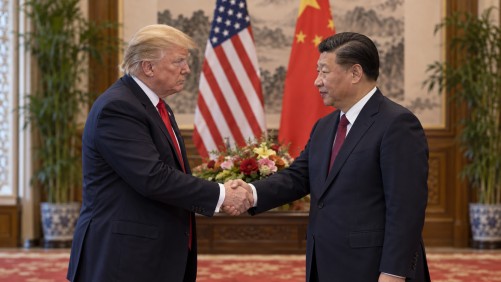
The upcoming meeting between US President Donald Trump and Chinese President Xi Jinping carries significant implications for global trade, technology governance, and geopolitical stability. As the two leaders prepare for their second face-to-face discussion this year, they aim to navigate complex disagreements that could impact international markets and security frameworks.
A major point of discussion will be artificial intelligence (AI), a sector both nations are heavily invested in. The United States has proposed establishing a dialogue channel with China on AI safety and governance, highlighting the necessity for cooperation in this rapidly advancing field. However, differing perspectives on AI risks and development continue to pose challenges. The US has placed restrictions on China’s access to advanced semiconductors crucial for AI, while China accuses the US of trying to hinder its technological growth.
Trade relations between the two countries are also under scrutiny, with a temporary trade agreement set to expire in November. This agreement, which includes tariff measures and restrictions on Chinese rare-earth exports, has been a focal point in negotiations. While Beijing seeks longer-term stability, Washington views these restrictions as leverage. The outcome of these talks could significantly alter the trade landscape.
Taiwan remains a contentious issue, potentially influencing future US-China relations. The United States has maintained defense ties with Taiwan, a stance opposed by China, which considers Taiwan part of its territory. US arms sales to Taipei could exacerbate tensions, making it a critical topic of discussion in the meeting between Trump and Xi.
The leaders are also expected to address broader international concerns, including conflicts involving Iran and Ukraine. China’s economic ties with Iran and its relationship with Russia add complexity to these discussions. As both nations strive to manage their strategic rivalry, their dialogue will be crucial in shaping future global dynamics.
