
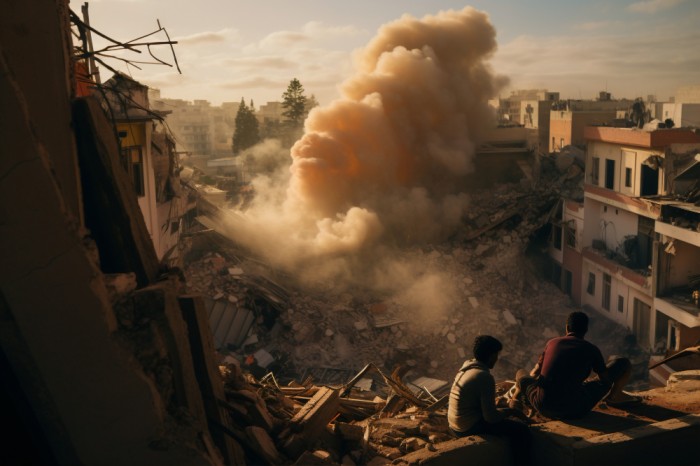
The United States and Iran have found themselves at a heightened state of tension following a series of retaliatory strikes, igniting fears of an expanded conflict in the Gulf region. The U.S. military announced that it had conducted operations targeting Iranian assets, specifically focusing on air defense systems, drone facilities, and surveillance capabilities. This was in response to an attack on a commercial vessel in the strategic Strait of Hormuz, a critical route for global energy trade. U.S. officials described the strikes as a necessary measure to mitigate Iranian threats in this pivotal maritime corridor.
In a swift counteraction, Iran’s Islamic Revolutionary Guard Corps claimed responsibility for launching missile and drone assaults on military facilities linked to the U.S. in Kuwait and Bahrain. Despite Iranian assertions that they successfully hit several targets, including a U.S. air base in Kuwait and a naval installation in Bahrain, these claims have yet to be independently verified. The governments of Kuwait and Bahrain have since issued security alerts, detecting incoming missiles and drones, and have activated their defense systems. Residents have been advised to seek safer areas amid the ongoing unrest.
This exchange of military actions has intensified worries about the potential collapse of the already fragile ceasefire between Washington and Tehran. The Strait of Hormuz continues to be a focal point of geopolitical friction, with both nations previously engaging in confrontations over this vital waterway. The latest incidents underscore the ongoing volatility in the region, highlighting the critical nature of maintaining security in one of the world’s most important maritime passages.
President Donald Trump has accused Iran of breaching the ceasefire agreement, issuing a stern warning that further military responses could be on the horizon if tensions persist. In contrast, Tehran has placed the blame squarely on Washington’s shoulders, accusing the U.S. of instigating the escalation and breaching prior agreements. As both sides exchange accusations, the international community watches closely, concerned about the potential for further destabilization in the region.
